1983 dime value is often searched because collectors hear two things at the same time: the coin is common, but high-grade examples can sell for strong money. That contrast creates confusion. Is it just ten cents, or is there real upside? The answer depends on condition, strike quality, and one key detail: Full Bands. If you need some quick answers:
- The 1983 dime is not rare by mintage.
- Most pieces in circulation are worth face value.
- Weak strike is common for this year dimes.
- Full Bands (FB) changes the price structure.
- Premium begins at high Mint State grades.
Everything revolves around preservation. Let’s discuss all in detail.
What Is the 1983 Dime?
The 1983 dime belongs to the Roosevelt series. It was struck in two mints for circulation:
- 1983-P (Philadelphia)
- 1983-D (Denver)
San Francisco struck proof coins, but circulation issues came only from P and D.
Design remains standard:
- Obverse: Roosevelt portrait
- Reverse: Torch, olive branch, oak branch
The torch is the key area for grading. That is where Full Bands appear.
Basic Specifications
| Feature | Detail |
| Year | 1983 |
| Denomination | 10 Cents |
| Composition | Copper core, nickel-clad outer layer |
| Weight | 2.27 g |
| Diameter | 17.91 mm |
| Edge | Reeded |
| Mints | P, D (circulation) |
| Proof Mint | S |
The coin is clad, not silver. No intrinsic metal value supports the price. Market value comes from collector demand.
Is the 1983 Dime Rare?
No.
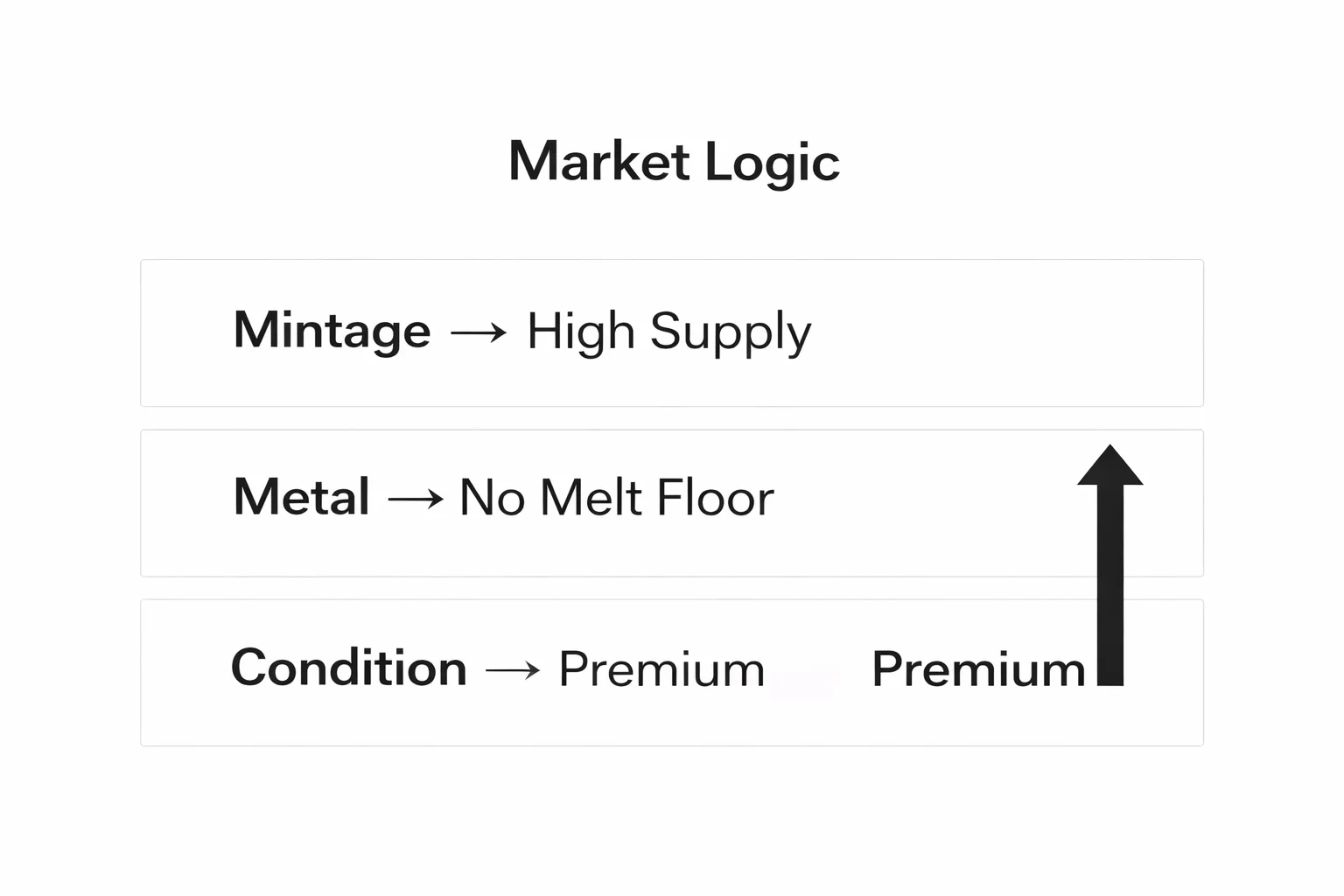
Mintage numbers were high for both Philadelphia and Denver. Tens of millions entered circulation. The coin appears regularly in change.
Age does not create rarity. Supply does.
The 1983 dime is widely available in worn condition. Even lightly uncirculated pieces can be found without difficulty.
Where scarcity begins is at the top of the grading scale.
Weak Strike: A Known Characteristic
The 1983 dime is often associated with a weak strike. This is not a wear, but an incomplete detail from the moment of production.
Where weak strike shows:
- The horizontal bands on the torch
- Fine lines in the flame
- Small elements near the center of the reverse
High-speed production and die fatigue affected detail clarity. As a result, strong examples are less common than average ones.
Weak strike reduces the chance of achieving Full Bands.
That matters.
1983-P vs 1983-D: Is One Better?
Both mints produced large quantities. Neither is scarce by mintage. Differences appear in strike consistency and surface quality.
| Feature | 1983-P | 1983-D |
| General Availability | High | High |
| Weak Strike Frequency | Common | Also common |
| High-Grade Survival | Limited | Limited |
| FB Examples | Scarcer than average | Also scarce |
There is no dramatic rarity gap between P and D. The market does not treat one as a key date. Collectors focus on condition, not the mint mark.
Full Bands (FB): The Key Factor
Full Bands refers to the horizontal bands on the torch being fully separated. The lines must be clear and uninterrupted.
Many 1983 dimes do not meet this standard. Strike softness often causes partial merging.
Do Full Bands examples exist for 1983? Yes. They are real. They are simply harder to find.
That difficulty changes the price structure. Without FB, even a high-grade coin may stay moderate in value. With FB, demand increases sharply.
Real Market Prices
The market follows a clear pattern that you can check in the table below:
Circulation and Lower Mint State
| Condition | Typical Value |
| Circulated | $0.10 |
| AU | $0.10–$0.25 |
| MS63 | $2–$4 |
| MS65 | $5–$12 |
Most coins remain close to face value. Even bright, uncirculated pieces stay affordable.
Higher Mint State
| Grade | Typical Value |
| MS67 | $40–$100 |
| MS67 FB | $150–$400 |
| MS68 | $400–$800+ |
| MS68 FB | $1,000+ |
Prices vary by certification service and eye appeal. Auction records show strong premiums at MS67 and above, especially with FB.
The jump between MS66 and MS67 can be large. The jump from MS67 to MS67 FB can be larger.
Grade creates value.
Tip: Use a reliable tool to confirm the value and nuances. After checking the condition and bands, identification tools can help confirm mint, composition, and typical market range. Coin ID Scanner, for example, allows photo-based identification and provides a coin card with year, type, metal, weight, diameter, and estimated value range. Its database includes over 187,000 coins, and the AI assistant helps to ask any quotations.
This helps with quick sorting. Final value still depends on grade and, if needed, certification.
Errors: What Matters and What Does Not
Many coins labeled “error” online are normal production variations.
Common but low-value issues:
- Machine doubling
- Minor die cracks
- Slight strike weakness
These rarely add a significant premium.
Errors that can carry value:
- Strong off-center strikes
- Major planchet defects
- Dramatic misalignment
Even then, strength and visibility matter. Certification helps confirm authenticity.
The majority of 1983 dimes sold as “rare errors” are ordinary examples.
Why High Grades Are Difficult
Clad dimes are prone to contact marks. The copper core and nickel surface show small hits easily. Coins were stored in bulk bags. Friction occurred before they ever reached circulation.
Key limiting factors:
- High-speed minting
- Bag contact
- Thin surface layers
- Strike softness
As a result, MS67 and above pieces are selective. MS68 examples are rare in certified populations.
This is a conditional rarity. Not a date rarity.
Proof Versions
1983-S proof dimes were struck for collectors. They feature mirrored fields and sharper detail.
Typical values:
| Grade | Typical Value |
| PR65 | $3–$6 |
| PR67 | $5–$12 |
| PR69 | $15–$30 |
| PR70 | $50+ |
Proof coins are common in lower grades. Premium appears in the top preservation levels.
Full Bands does not apply the same way in proofs, but sharp detail still influences price.
Should You Keep a 1983 Dime?
Keep it if:
- The surfaces are clean.
- Strike is strong.
- Bands appear fully separated.
- It looks capable of MS67 or higher.
- It may qualify for FB.
Do not store large quantities of circulated pieces expecting appreciation. Supply is large. Demand is selective.
A focused approach works better. Remember – save quality, not quantity.
Conclusion
The 1983 dime is not a scarce date. It is a high-mintage clad issue. Most coins remain worth ten cents.
Value appears at the top of the grading scale. Full Bands changes demand. Strong strike and clean surfaces matter more than age.
The market rewards quality.
If you find a sharp 1983 dime with clear bands and minimal marks, you may have something worth examining further. Otherwise, it is simply part of everyday coinage history.