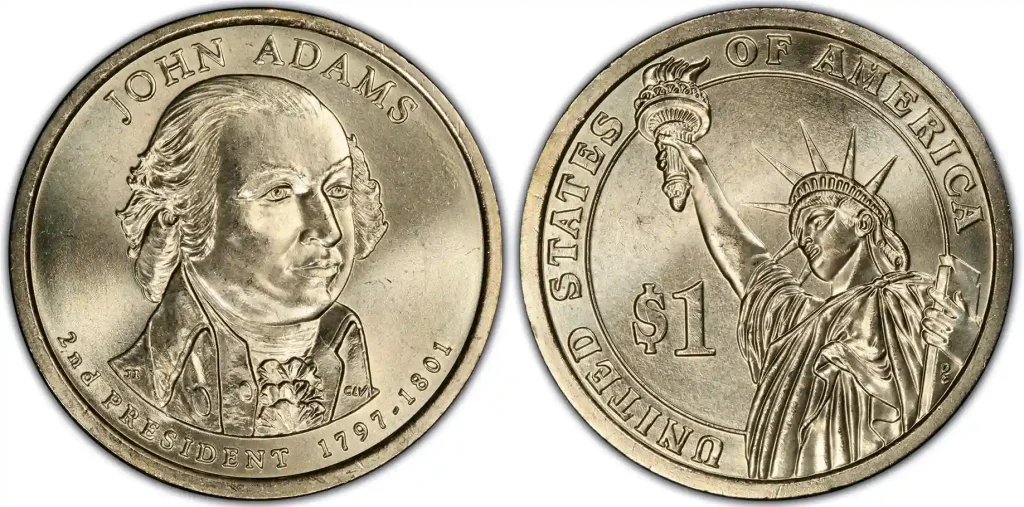
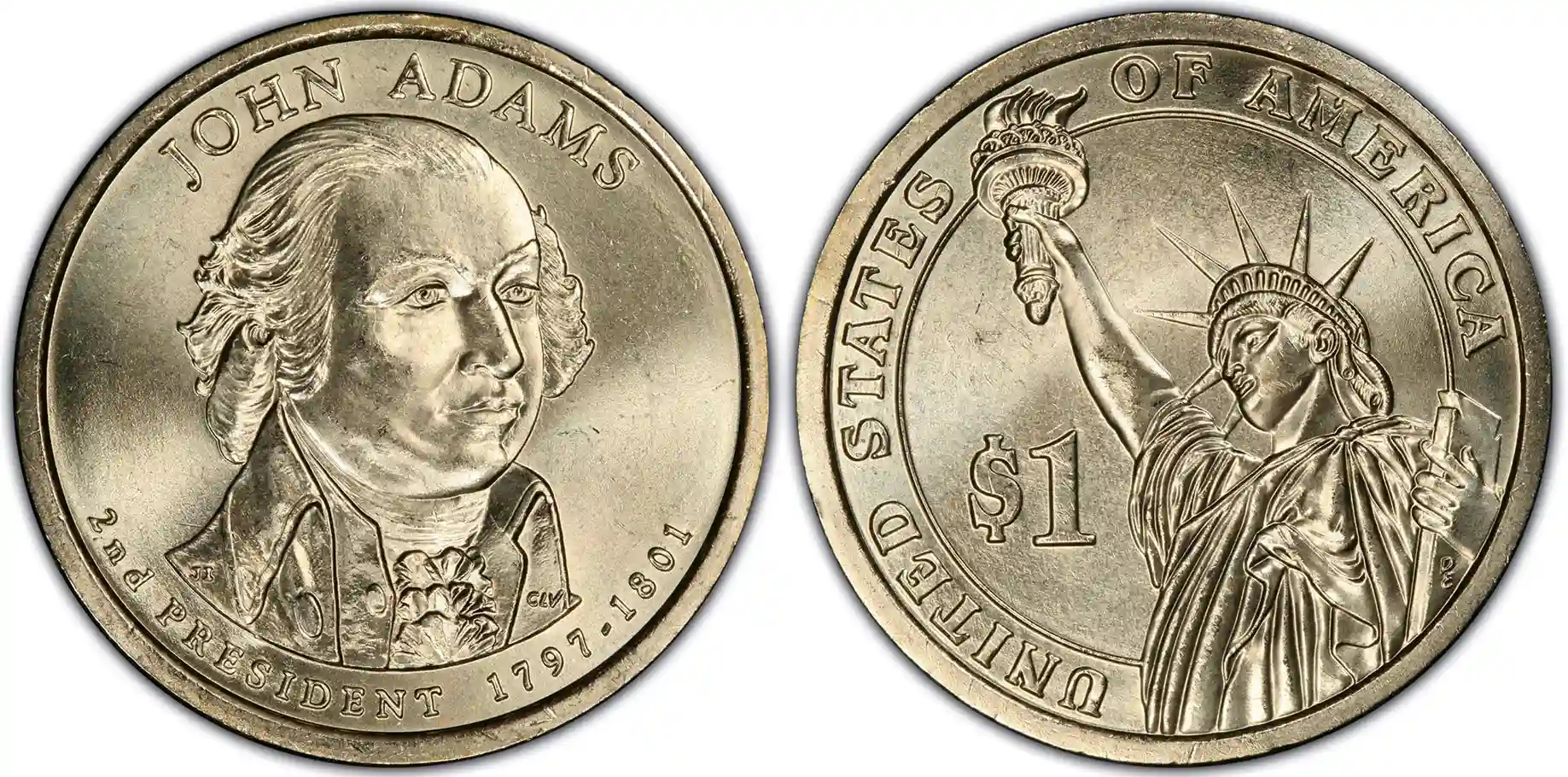
The John Adams dollar coin value starts from face value 1 dollar and reaches more than $2,000 at the auctions. Unique errors and the edge lettering varieties change the price in the numismatic market.
The Presidential Coin Overview
| Year | 2007 |
| Diameter | 26.50 mm |
| Weight | 8.10 g |
| Composition | Mostly copper |
George Washington appeared on the first coin. The John Adams dollar followed immediately as the second release in the series. The public showed initial interest in these golden-colored issues. The Mint produced millions of them to satisfy commercial banks and collectors across the country.
Why Most John Adams Dollars Remain Worth Exactly One Dollar
If you find a John Adams dollar in a cash drawer today, it likely carries a value of just one dollar.
- Total Mintage – 224 million
- The Philadelphia Mintage – 112.4 million pieces
- The Denver Mintage – 112.1 million pieces
Plain Edge Coin Error
The Presidential dollar series brought a major design shift to American coinage. The Mint moved the date, the mint mark, and national mottos from the flat faces of the coin to its outer edge.
To achieve this, the Mint utilized a two-step manufacturing process. First, standard coin presses struck the obverse and reverse designs onto the blank metal discs.
Next, the struck pieces rolled through a separate piece of machinery called a Schuler edge-lettering machine. This device pressed the required text into the smooth outer rim of the coin.
The “Godless” Adams Dollar
Mechanical errors happened during the initial production year. Sometimes, bins of struck coins bypassed the Schuler machine entirely. These coins went straight to packaging without any edge text.
Because the edge contained the phrase “In God We Trust,” these mistake coins lacked the national motto entirely. The public noticed this omission quickly.
People and news outlets gave these items a specific nickname: the “Godless Dollar.” The John Adams release suffered from this production lapse more than other designs in the series.
Real Market Values for the Plain Edge John Adams Error
| Grade | Value |
| MS-64 | $50–$75 |
| MS-65 | $100–$150 |
| MS-67 | $400+ |
The missing text mistake turned ordinary dollar coins into valuable items overnight. While a regular John Adams dollar buys a snack, a certified plain edge error version can command significant money.
The Edge Lettering Varieties: Position A vs. Position B
| Feature | Position A | Position B |
| Visual Orientation | The edge text reads upside-down when the presidential portrait faces upward | The edge text reads right-side-up when the presidential portrait faces upward |
| How It Happened | The coin fell into the edge-lettering machine with the obverse side facing downward | The coin fell into the edge-lettering machine with the obverse side facing upward |
| Production Rarity | Common | Common |
| Hobby Status | Normal Variety | Normal Variety |
What Does Position A and Position B Mean?
When you examine a normal John Adams coin, look closely at the direction of the edge text relative to the portrait. Numismatists classify these coins into two categories: Position A and Position B.
Position A means that when Washington or Adams faces up, the edge lettering appears upside down. Position B means that when the portrait faces up, the edge lettering reads normally from left to right. This difference occurs because of how the coins dropped into the edge of the machine.
Does the Orientation of the Text Affect the Coin’s Value?
The direction of the text does not create a price premium. The Mint did not align the blanks in a specific direction before they entered the Schuler machine. The coins fell into the feeder randomly.
Statisticians note that roughly half of the entire production run features Position A text. The remaining half features Position B text. Because both varieties exist in nearly equal amounts, coin dealers treat both options as standard issues.
Upside-Down Lettering: A Common Misconception Among Novice Collectors
People frequently mistake Position A text for a rare factory error. A person looks at the rim, notices that the words read upside down, and assumes they found a masterpiece.
This belief represents a major misconception in the coin hobby. The Mint considers both text orientations completely acceptable. Professional price guides list identical values for both positions across almost all grades.
John Adams Dollar Error List
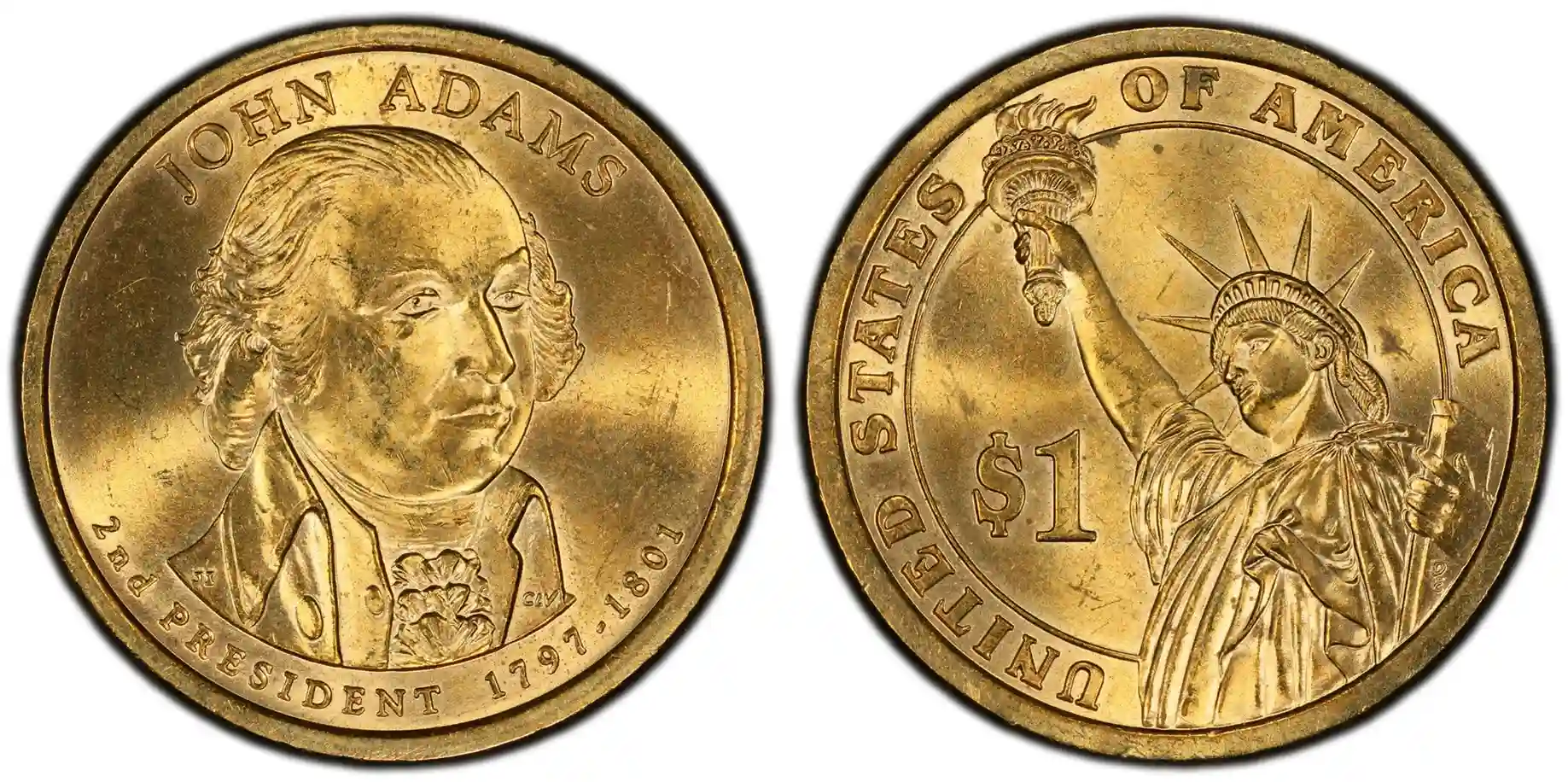
Double Edge Lettering
Another verified error occurred when a coin slid through the Schuler machine two times. This double pass created two sets of text on a single rim.
Sometimes the text is aligned in the same direction, which blurs the letters. In other instances, the coin flipped over before the second pass, which created inverted, overlapping sentences. Collectors actively hunt for these double edged text variations.
Value $30–$100+
Off-Center and Partial Collar Striking Blunders
Problems also happened during the primary strike phase. If a blank disc did not center properly inside the coining chamber, the die struck it off-center. This left a portion of the design missing.
A partial collar error occurred when the steel retaining ring that secures the coin’s edge did not rise completely. The metal flowed over the top of the ring during the strike, which created a lip on the coin. Collectors call this a railroad rim error.
Value $50–$150+
Auction Records
Public auction data confirms the real value of verified John Adams errors. Collectors bid thousands of dollars when unique pieces enter the market, before checking coin-identifier.com.
For example, a rare combination error that featured both a plain edge and an off-center strike fetched over $1,500 at a public auction. Double edge lettering varieties in high uncirculated grades frequently bring $200 to $500, depending on the clarity of the overlapping letters.
| Grade | Value |
| MS-68 Philadelphia PCGS | $2,500+ |
| MS-68 Denver NGS | $1,200+ |
Standard circulation strikes without errors also secure high auction prices if they possess a perfect surface. These values prove that condition rarity can match or exceed the value of physical production errors.